Who's the Best for Enterprise Imaging Solutions: Fujifilm vs Medicai
Many imaging teams still juggle multiple logins and scattered archives when they need to compare studies across hospitals. That friction slows referrals and delays treatment decisions.
By the end of this article you will have a side-by-side look at cloud PACS access, AI-supported workflows, zero-footprint viewing, and pricing for Medicai and Fujifilm, so you can pick the platform that fits your multi-site workflow without hidden trade-offs.
Quick Verdict: Medicai vs Fujifilm for Enterprise Imaging
Medicai offers a cloud-native, zero-footprint DICOM platform with 1 M+ studies processed yearly and 50 M+ yearly API transactions, while Fujifilm Enterprise Imaging is a legacy-heavy suite mixing on-premise servers and hybrid cloud options.
Three decision factors separate these solutions. Each hospital must weigh these elements against their specific requirements.
- Deployment model and scalability: Medicai runs entirely in the cloud and scales with demand. Fujifilm requires on-premise hardware or hybrid setups that need local maintenance.
- Total cost of ownership: Medicai eliminates server purchases and IT staff overhead. Fujifilm carries ongoing infrastructure and upgrade costs.
- AI integration and interoperability: Medicai connects through APIs and supports modern standards. Fujifilm relies on older protocols and slower connection cycles.
Medicai holds HIPAA and GDPR compliance with FDA and CEE cleared viewers. These certifications support safe image exchange across borders. Hospitals can move imaging studies without extra security layers.
Fujifilm maintains its place in many large radiology departments. Its long history in diagnostic imaging gives it an established user base. Many organizations still run legacy systems that require careful migration planning.
Overall, Medicai delivers faster deployment and lower operating costs for most enterprise imaging needs. Its cloud approach reduces hardware complexity and accelerates rollout across multiple sites.
At a glance: how Medicai compares to Fujifilm on the features that matter most.
| Feature | Medicai | Fujifilm |
|---|---|---|
| Enterprise Imaging Solutions | ✓ | ✗ |
What Is Medicai?
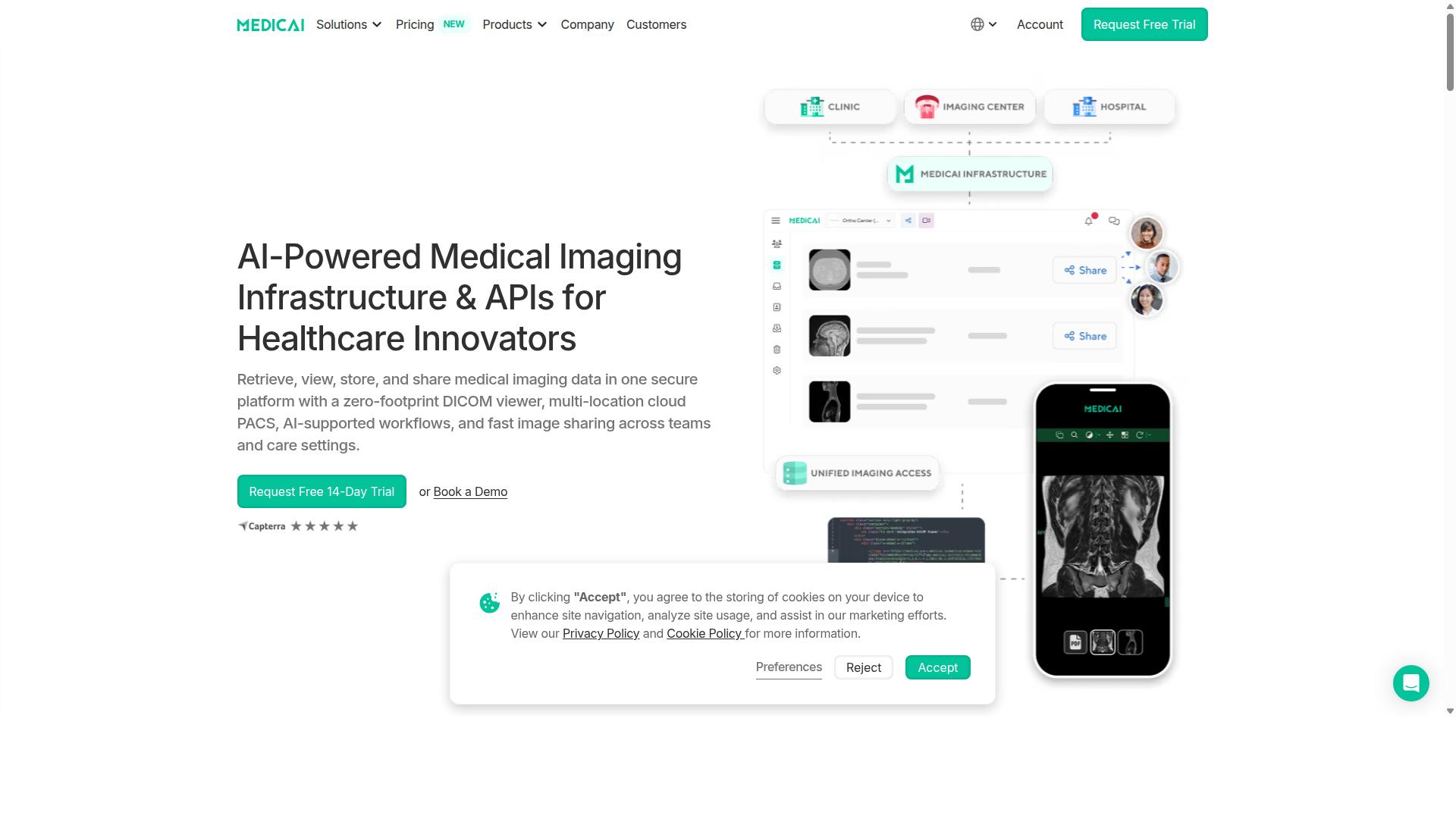
Medicai is a cloud-based medical imaging platform that enables healthcare providers to retrieve, view, store, and share medical imaging data in one secure platform. The solution focuses on enterprise imaging needs across multiple care settings.
Zero-footprint DICOM viewer technology removes the need for local software installations. Users access studies through any standard web browser without additional plugins or downloads.
This approach supports fast deployment across hospital networks. IT teams avoid managing client-side updates or compatibility issues when onboarding new facilities.
Medicai currently stores over 1.7 million studies. The platform maintains HIPAA and GDPR compliance while holding FDA and CEE clearance for diagnostic use.
Integration occurs through HL7 and FHIR standards. These connections allow data exchange with existing hospital systems without custom development work.
The platform offers multi-location cloud PACS capabilities. Organizations can consolidate imaging archives from different sites into a single, accessible repository.
AI-supported workflows help radiologists prioritize urgent cases. This automation reduces time spent on routine image routing and preliminary analysis tasks.
When compared to traditional enterprise imaging systems like Fujifilm, Medicai eliminates hardware dependencies. Cloud architecture removes the need for on-premise servers and local maintenance contracts.
Healthcare systems can scale storage capacity without purchasing additional infrastructure. This flexibility proves valuable during periods of rapid organizational growth or seasonal volume changes.
What Is Fujifilm?
Fujifilm Enterprise Imaging is an established medical imaging suite that combines PACS, VNA, and RIS modules, typically deployed in hybrid on-premise and cloud configurations.
The platform addresses enterprise imaging needs through integration with radiology information systems and supports multi-site deployment across different healthcare facilities.
Healthcare organizations often evaluate Fujifilm when they require a traditional vendor with established market presence in the diagnostic imaging space.
Many facilities consider how such legacy systems align with their existing radiology workflow infrastructure and current interoperability requirements.
Research suggests that organizations reviewing enterprise imaging solutions should examine factors such as data migration complexity, ongoing maintenance requirements, and how well each option fits their specific clinical environment needs.
Features Compared
The feature comparison is broken into three focused areas: cloud access, AI-supported workflows, and image sharing.
Enterprise imaging platforms must handle growing study volumes across multiple sites while maintaining data security and workflow efficiency. Cloud solutions offer scalability that traditional on-premise systems often struggle to match.
Both Fujifilm and Medicai provide enterprise imaging capabilities, yet their approaches to deployment and integration differ substantially. The following sections examine how each vendor addresses these critical requirements.
Cloud PACS and Multi-Location Access
Medicai's Standard tier ($749/month) includes 2 TB of cloud storage and one connected location, allowing immediate DICOM access across multiple sites without hardware upgrades.
Traditional PACS systems require extensive infrastructure investments at each facility. Cloud-based approaches eliminate these barriers while enabling radiology teams to expand their reach.
A radiology team can follow these steps to add a new location: 1) activate the DICOM Gateway, 2) enable cloud PACS replication, 3) assign role-based access through the cloud console.
Medicai's 1.7 M+ studies demonstrate proven scalability for growing medical imaging operations. Fujifilm systems typically rely on on-premise hardware that demands significant upfront investment and ongoing maintenance.
Multi-site deployments benefit from centralized management that reduces administrative overhead. Cloud imaging platforms provide the flexibility needed for expanding healthcare networks.
AI-Supported Workflows and Structured Reporting
Partner integrations with Rayscape.ai, MD.ai, and Boehringer Ingelheim let Medicai run AI algorithms directly against the cloud archive and return structured reports to the viewer.
AI integration in radiology workflows continues to transform diagnostic imaging capabilities. Machine learning models process increasing volumes of medical imaging data while maintaining accuracy standards.
An AI model processes a chest CT, flags a suspected nodule, and inserts results into the FHIR report. This automated workflow reduces manual review time while maintaining clinical oversight requirements.
300 k+ visualizations processed last year serve as evidence of AI-enabled throughput in medical imaging applications. Fujifilm's AI capabilities remain more limited compared to platforms with multiple specialized partnerships.
Structured reporting ensures consistent documentation across different clinical settings. Interoperability standards like FHIR enable seamless data exchange between systems and departments.
Zero-Footprint DICOM Viewer and Image Sharing
Medicai's web-based viewer runs in any browser, supports 3D reconstruction and hanging protocols, and lets referring physicians open studies via a secure link without VPN or software installs.
Traditional image sharing methods create delays that impact patient care coordination. Zero-footprint viewers eliminate installation requirements while maintaining security standards.
The sharing workflow follows these steps: 1) upload study via Medical Imaging Uploader, 2) generate time-limited link, 3) recipient authenticates with role-based access, 4) audit trail records every view. HIPAA/GDPR compliance remains maintained throughout this process.
Fujifilm's image sharing often requires additional software installations or VPN connections that complicate access for external physicians. Modern medical imaging platforms prioritize accessibility without compromising security.
Role-based access controls ensure appropriate permissions while maintaining complete audit trails. Cloud-based image exchange platforms provide the flexibility needed for contemporary radiology practices.
Pricing Compared
Medicai publishes transparent monthly plans starting at $249 for 500 GB and $749 for 2 TB with unlimited accounts, while Fujifilm pricing is contract-based and hardware-dependent.
Transparent pricing helps healthcare organizations plan budgets without lengthy negotiations. Medicai offers clear tier options that scale with needs, making enterprise imaging accessible for various practice sizes.
| Plan | Price | Storage | Connected Locations | Key Features |
|---|---|---|---|---|
| Starter | $249/month | 500 GB | None | Unlimited user accounts, 14-day free trial |
| Standard | $749/month | 2 TB | One | Unlimited user accounts, DICOM Gateway included |
Fujifilm requires custom quotes that cover servers, software licenses, and maintenance. This approach often involves hardware procurement and ongoing support contracts that extend implementation timelines.
Yearly billing provides 15% savings for organizations choosing annual commitments. The Starter plan costs $209 monthly and the Standard plan costs $639 monthly when paid yearly. Enterprise customers receive custom pricing based on specific storage and connectivity requirements.
Additional costs include a one-time $1,000 DICOM Gateway setup fee per location. Per-study pricing options exist for enterprise customers who prefer usage-based billing rather than fixed monthly subscriptions.
Who Should Choose Medicai
Hospitals, imaging centers, and specialty groups seeking rapid cloud deployment and predictable costs should evaluate Medicai first.
Multi-location orthopedic practices benefit from instant image exchange across sites. Enterprise imaging demands reliable connectivity between clinics, surgery centers, and referring physicians. Medicai processes over 1 M studies yearly and handles more than 50 M API transactions without infrastructure delays.
Neurology clinics migrating from on-premise PACS often face lengthy data migration timelines. Cloud imaging reduces hardware maintenance while maintaining diagnostic quality. The platform supports DICOM workflows and HL7 connectivity to existing systems without extended downtime.
Teleradiology providers require zero-footprint access for radiologists working across multiple contracts. Web-based viewer capabilities enable secure reading from any location. Multi-site deployment becomes simpler when each new facility connects through standard web browsers.
Each scenario demonstrates how interoperability and scalability support different care settings. Medical imaging teams gain flexibility when infrastructure scales with patient volume rather than hardware purchases. These practical advantages appear across various clinical environments.
Who Should Choose Fujifilm
Large health systems already invested in Fujifilm hardware or requiring deeply customized on-premise workflows may continue with Fujifilm. These organizations often maintain existing RIS/PACS bundles that align with their current infrastructure.
Strict data-residency policies represent another reason to consider Fujifilm. Some regions mandate that medical imaging data remain physically located within national borders, eliminating the possibility of cloud imaging solutions.
Long-term service contracts can lock organizations into Fujifilm solutions for extended periods. When hardware maintenance agreements span multiple years, switching vendors becomes costly and complex.
Established radiology departments with specialized modality worklist requirements may find Fujifilm's customization options meet their needs. These teams often have dedicated IT staff experienced with Fujifilm's on-premise architecture.
Organizations facing multi-site deployment scenarios sometimes prefer Fujifilm when they need exact replication of existing workflows across locations. The vendor neutral archive capabilities can support image archive consolidation efforts.
Final Verdict
For organizations prioritizing cloud scalability, transparent pricing, and rapid AI integration, Medicai presents the stronger option.
Enterprise imaging teams that need fast deployment across multiple sites often face delays with traditional on-premise systems. Medicai avoids these delays through its zero-footprint viewer that runs directly in any modern browser without software installation.
Budget planning becomes easier when imaging departments know exactly what they will pay each month. Medicai offers predictable monthly plans that eliminate the surprise costs common with hardware upgrades or license renewals.
High volume operations require platforms that have already proven they can handle large workloads. Medicai processes 1 M+ studies per year, giving leadership confidence that the system will maintain performance as case numbers grow.
Organizations that want to evaluate these capabilities can request a live demo through either office location. Medicai USA is located at 7901 4th St N, STE 300, St. Petersburg, FL, 33702, reachable at +1 (832) 220 1035. Medicai Romania operates from 53-55 N Filipescu, 5th Floor, Sector 2, Bucharest, 020961, with phone +40 316 305 875. Both sites share the email address sales@medicai.org for scheduling demonstrations.